
Recognizing Disability Pride Month
The World Works Better With Us
More than 1 in 4 U.S. adults, over 70 million people, live with a disability.
Most of us don’t think we know that many people with disabilities.
But statistically, we do. Think about your closest friends, coworkers, family, and neighbors.
Someone you know, work with, or care about is living with a disability, whether it is visible or not.
Many others are balancing work while caring for a child, parent, partner, or loved one living with a disability or chronic health condition.
The question isn’t whether disability is part of our lives. It’s whether we’ve noticed.
That realization has changed the way I think about Disability Pride Month.
I’ll admit, I have mixed feelings about commemorative months.
Mainly because awareness without action can feel performative. Conversation without continued commitment rarely leads to lasting change and can feel hollow.
This year’s theme, The World Works Better With Us, challenged me to think less about awareness and more about action.
More specifically, it made me wonder whether the barriers people face are always theirs…or whether many of them are barriers we’ve unintentionally created.
Rethinking Disability
One of the biggest misconceptions about disability is that it is defined by what someone cannot do.
Disability is often less about a person’s capability than it is about the barriers we unintentionally create.
The right tools, thoughtful design, and accessible environments don’t lower expectations. They remove unnecessary obstacles so people can contribute, grow, and thrive.
Accessibility rarely benefits just one person.
Curb cuts were designed for wheelchair users. Today, they also benefit parents pushing strollers, travelers with luggage, delivery workers, cyclists, and countless others.
Closed captions were created for people who are deaf or hard of hearing. Today, they’re used everywhere from airports and classrooms to gyms and busy offices.
Voice-to-text and audiobooks were developed to improve accessibility. Today, they’re simply part of everyday life for millions of people.
Accessibility isn’t about making exceptions. It’s about designing better systems from the beginning. The same principle applies in our workplaces.
Designing for Human Variability
As someone who works in safety, this principle resonates deeply with me.
Throughout my career, I’ve worked alongside talented people whose contributions flourished when barriers were removed and whose potential was sometimes overlooked when those barriers remained.
Those experiences have reinforced a simple lesson: people perform best when systems are designed around the realities of human experience rather than forcing everyone into a single mold.
Good safety systems aren’t built for an “average” worker. They’re built with the understanding that people learn, communicate, move, and respond differently.
The same is true for accessibility.
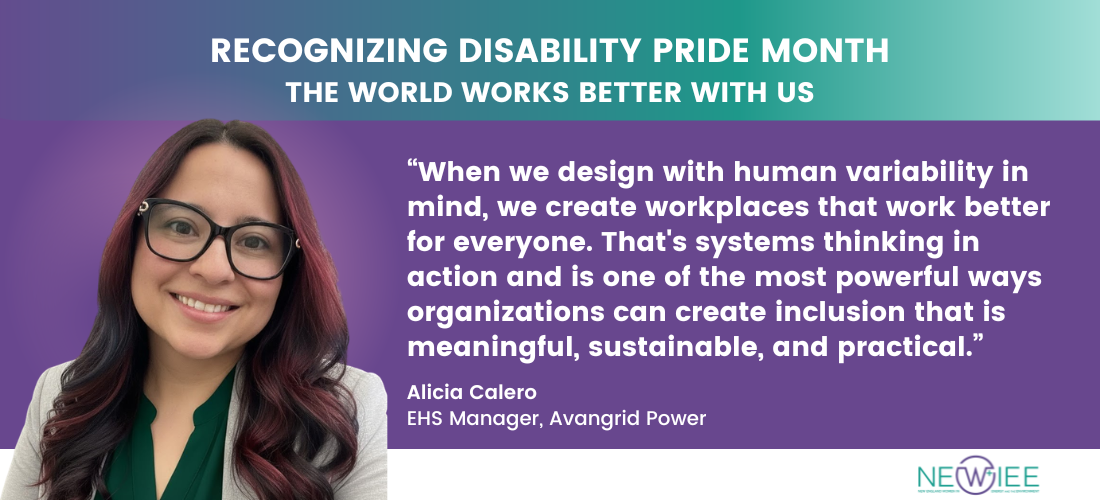
When we design with human variability in mind, we create workplaces that work better for everyone.
That’s systems thinking in action and is one of the most powerful ways organizations can create inclusion that is meaningful, sustainable, and practical.
Small Actions Create Meaningful Change
So rather than asking how we recognize Disability Pride Month, perhaps a better question is:
What’s one barrier we can remove today?
Maybe it’s simplifying something that’s always been more complicated than it needs to be.
Maybe it’s designing meetings where everyone has an opportunity to participate.
Maybe it’s asking the people closest to the work what would make their jobs easier instead of assuming we already know.
Or maybe it’s creating a culture where asking for help is seen as a strength, not a weakness, and no one feels they have to hide, mask, or minimize what they need to succeed.
None of these actions are extraordinary.
But together, they create better workplaces, stronger teams, and better outcomes.
Meaningful change rarely happens all at once.
It happens one thoughtful decision at a time.
A Simple Question
So, I leave you with this:
What’s one barrier you can remove today?
Disability Pride Month reminds us that accessibility is not about accommodating a few people. It’s about creating environments where more people can contribute their talents, perspectives, and potential.
When we design for human variability, we create better systems, stronger communities, and more opportunities for people to thrive.
The world truly works better with us.
Written by
Alicia Calero
EHS Manager, Avangrid Power
Member NEWIEE DEI Committee
© 2026 New England Women in Energy and the Environment (NEWIEE). NEWIEE is a non-profit, tax exempt organization under Section 501(c)(3) of the Internal Revenue Code.